Test, Test, Test
Replaced the whey with a joghurt water mix. The outside looks the same.

#bread #brot #sourdough #LievitoMadre #Sauerteig #whey #molke
Test, Test, Test
Replaced the whey with a joghurt water mix. The outside looks the same.

#bread #brot #sourdough #LievitoMadre #Sauerteig #whey #molke
A series of posts on Rhenish Stoneware
#history #archaeology #rhineland #stoneware #steinzeug #retirement
When I retired I decided on a “project” to keep busy and learn and see interesting things. As I live in Cologne, an important medieval trading centre, I had the idea to follow some of the trade goods, ideally by bicycle and taking photos on the way.
The first trading good I followed was stoneware.
Ok, done
In November 2025 I jumped on my bike and visited Frechen to visit the Keramion and see what there was still to see of the stoneware pottery history.
There was a lot, industrial stoneware eg sewage pipes were produced there until quite recently. Of course the medieval stuff was more difficult.
Anyway, this is, what the most “famous” product of Rhenish Stoneware looks like, the Bartmann Krug.

What the visit to the Keramion (a museum for ceramics in Frechen) started to show, is that stoneware is easy to photograph individually, but slightly difficult to capture what makes it interesting besides being pretty.

First question, what is it, and what makes it special?
Stoneware pottery is heated to a much higher temperature and for longer than other types of pottery.
Normal pottery is baked between 600 C to about 1100 C. If you want it water tight, you need to glaze it.
Stoneware is baked between 1200 C and 1300 C. The result is water tight and acid proof as the clay is sintered at these temperatures. It is also more difficult to shatter. These properties explain why high quality sewage pipes are still made from stoneware.
But apart from the improved properties stoneware was also more expensive and more difficult to produce.
To produce stoneware you needed: high quality clay, wood, salt (for the glaze) and customers who were willing to pay more than for simple, everyday, pottery.
You also needed fairly tolerant neighbors, as the salt glazing produced chloric acid, which can’t have been a lot of fun.
In summary:
Starting with the customers, Cologne had been a major trade centre from Roman times and was well connected to markets via the Rhine, but also overland routes like the Via Belgica, the Via Regia, the Hellweg etc.
Trading pottery was also a thing since Roman times and Terra Sigillata wares were produced and traded.
This was a good thing for Cologne potters, but also for potters with access to the Cologne market.
This map shows the main pottery centers.

Stoneware is thought to have originated in Siegburg. Siegburg itself was dominated by Siegburg Abbey, which had been founded by Cologne Archbishop Anno II in 1046.
Siegburg pottery was traded locally, but was also sold via Cologne. The Sieg river was navigable in the Middle Ages and led to the Rhine just a bit south of Cologne.

There is a nice museum in Siegburg, which has a quite nice exhibition on stoneware.

My two museum visits showed that a bit more context would be good. Just visiting the pottery towns and their museums to take pictures of very similar looking (to the lay person) would be quite boring.
I started collecting books and academic papers on stoneware, pottery and everything that looked remotely connected.
For that I had to reactivate Obsidian, which I had used professionally before, to keep the stuff /semy/ organized.
Sidequests:
As I had somehow managed to miss the site, I went back to Frechen and looked at some kilns.


This brought me to a visit to Raeren (spring of 2026). With the car, because that exceeds my abilities (80 km one way). And because I passed it, I also visited Langerwehe.
First Raeren is pronounced with a long a (Raaren). Second, it is a German speaking bit of Belgium. Nothing to do with world wars though, it was part of the Spanish Netherlands.
Anyway, Raeren. There is a very good museum with an also very good website.
The museum is in the castle.

And here we find also some of the tools of the stoneware trade, namely molds

And the stoneware that could be made with molds.

My subsequent visit to Langerwehe was a bust. The Töpfereimuseum is closed for renovation (rebuilding?) and the interim exhibition was not yet ready.
I did have a brief talk with the resident potter (quite a nice shop actually). And he told me that while Raeren made stoneware for export, Langerwehe served local markets mainly.
So back on the list it goes
At the end of the Gothic period and the beginning of the Renaissance the cities on the Rhine and the Meuse held an ever larger group of people with a bit of money and a need to represent. A similar need was had by the lower nobility.
They wanted better tableware than their poor “cousins”, but pewter was out of the question. In parallel, more sophisticated (and longer lasting) stoneware drinking vessels could be seen in the taverns.
The stoneware followed the wine trade and the beer trade of the Hanse all the way to Scandinavia, Iceland, the Baltics, Russia, England, and of course what are today the Netherlands and Belgium.
From the Netherlands and England stoneware than crossed oceans.
There is a really fascinating project, Bartmann goes global that follows the stoneware to the Americas, Africa, Asia, South East Asia, even New Zealand and Australia.
More possible side quests:
These two styles influenced each other and Cologne painters worked in Flanders and Flemish painters in Cologne.
This could be linked to the printing trade including woodcuts, see also the Global spread of the printing press
I now reigning myself in. I don’t want to become an expert. I’m more of a dilettante in the 18th century meaning, ideally a broadband dilettante
What next:
Looking good, after using up the spelt wholemeal at Easter, this time rye wholemeal.
Now we need to wait for it to cool …

#bread #brot #sourdough #LievitoMadre #Sauerteig #whey #molke
The largest yet, might have better gone with a little lower temperature and a bit longer, seems a bit heavy. Talking about heavenly so is the crust and the smell.

#bread #brot #sourdough #LievitoMadre #Sauerteig #whey #molke
We spent a week in Sachsen-Anhalt exploring the Neolithic monuments of the Himmelswege in the Halle (Saale) area.
We chose a hotel in Merseburg, which was centrally located for our trip.
In theory, the trip should have taken 4.5 hours, but in practice, it took longer—especially since we brought our bicycles..
A few months ago, I discovered the himmelswege.de website while researching the Nebra Sky Disk. The site also introduced me to the Kreisgrabenanlage Pömmelte, which we had heard of, as well as Schönebeck and Goseck, which were new to us.
Since many of the sites appeared cyclable, we booked the hotel and set off.

The yellow parts of the map are mountains.
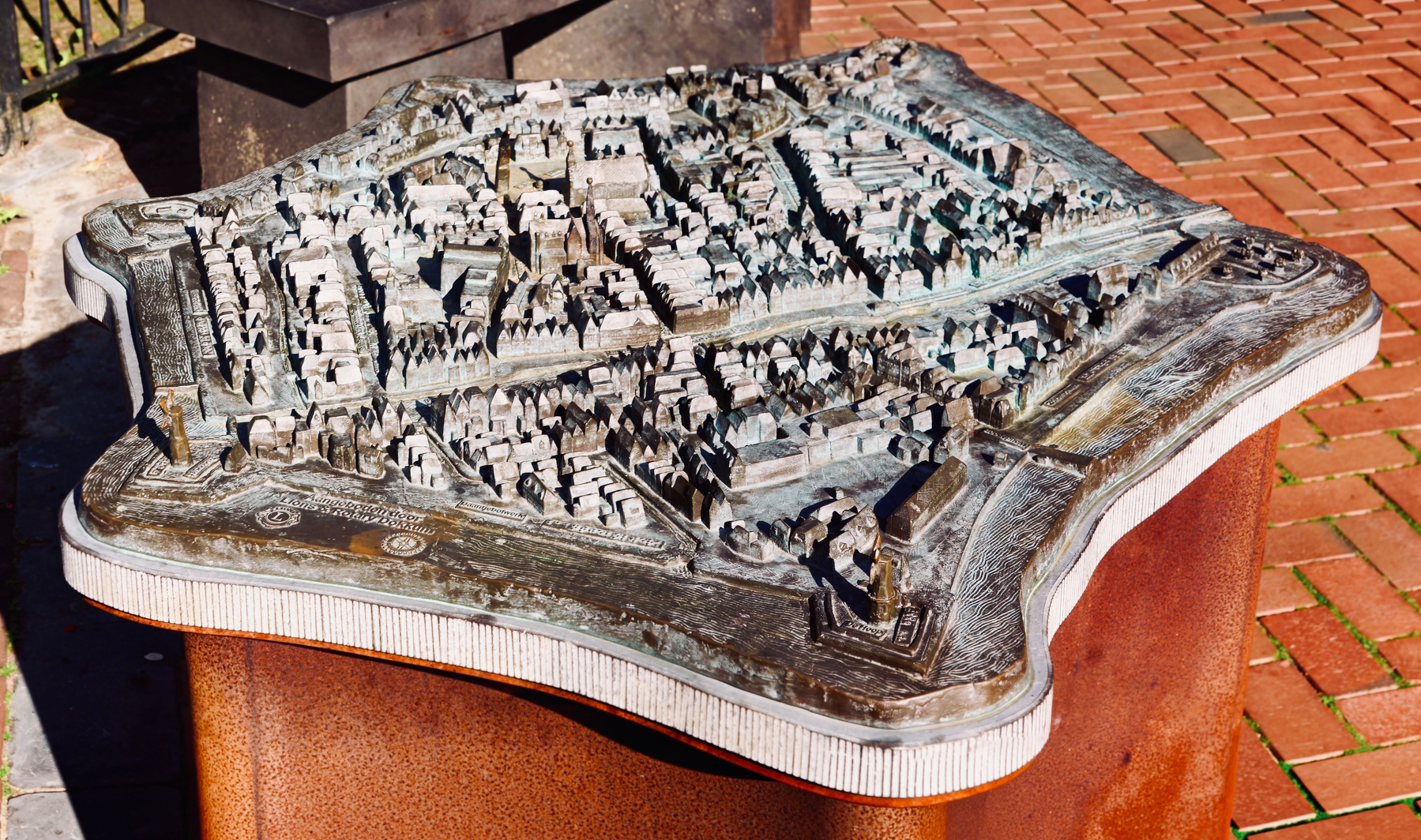
We found a tactile city map. So I’ll contrast a few buildings with map & reality (well, photo)


A ca 5000 year old wood circle, close to the confluence of Saale and Elbe.


The longest historic salt works in Europe


In the middle of the spas park in 1932 the grave of a neolithic shaman and her child was found. Now in the Museum in Halle.
www.landesmuseum-vorgeschichte.de/dauerauss…
A museum, basically in the middle of nowhere, sits near the spot where the Nebra Sky Disk was found. In a film presentation, the symbolism on the disc is explained, including the importance for people in the Neolithicum. The disk shows how from observation you can figure out, using the position of the Pleiades and the moon, when spring starts and when autumn starts.


A 7,000-year-old sun observatory.
It looks much simpler than the Ringheiligtum Pömmelte we visited earlier this week. But, it is the oldest sun observatory yet found anywhere.
The observatory sits below the top of a hill. The view takes in a large valley, stretching from the earliest sunrise in the year to the latest sundown of the year. Today, this is all mostly fields. Back then, you would have looked just above the treetops.


sonnenobservatorium-goseck.info
A very nice (smallish) museum, but very well made.
You start on the top floor with finds from about 400.000 years old from various cousins, including Erectus and Neanderthal and ending with Sapiens and the bronze age. Loads of finds. Rough stone tools, knapped stone tools, polished stone tools. The odd animal skeleton. The presentation is very good and the visitor leaves with a good and present impression of what life was like.


Himmelsscheibe front

Himmelsscheibe back

www.landesmuseum-vorgeschichte.de/en/
The first floor takes us from the beginning of the Iron Age to the Reformation.
Quite a short time compared to the floor above.
But because of the sheer number of objects and contexts this floor feels more condensed and “sped up”.
In short: There was trade with Rome, some served in the Roman Army, the Thuringians had their short lived kingdom, the Franks came, Christianity, Reformation, puh.


The last picture is the original in the Landesmuseum, see yesterday.
Same site as the Dolmengöttin, separated by a few meters and a few millennia


Medieval watchtower, build around 1000 CE by Heinrich I to watch for marauding Hungarians (there was more than the one tower, then)


We saw a few mill ruins, mostly Dutch-style mills; this was the only post mill.


This small spa was the summer holiday location for the court at Weimar, which explains why Goethe was seconded to help design the theater there and got to run it, as one of his jobs was theater director to the court.
Yesterday we managed to get here just after the cathedral closed. Today we got here in time to an open door for the town. The cathedral was way livelier than I like for photos. One of the things we looked at was the cathedral treasure vault under the cloister.

West Choir, this includes the famous sculptures of the founders


East Choir


Cycling on this trip was challenging. The weather was poor, and cycling infrastructure in the area is minimal. Many roads are cobblestone with no dedicated cycling paths, making for an uncomfortable ride—especially uphill.
We cycled through Merseburg, where our hotel was located, and rode through Halle with our bikes, though we drove there by car. Our visit to the Dolmengöttin was entirely by bicycle; on other days, we used the car.
Next time, we would leave the bicycles at home, not least because the bike rack increases fuel consumption.
As a tourist, you can feel a bit unwelcome—not due to the locals, but because of the infrastructure. Finding something to drink, eat, or a place to sit can be difficult. Presumably, this is because the tourist season only starts in April; we may have been too early.
Many places to eat serve only kebab, which can become monotonous.
There are many well-preserved historic sites, but locating them can be tricky. We did not find a single source listing all of them.
The Neolithic finds are well-documented and linked on himmelswege.de, though addresses are sometimes missing.
Other sites—such as Naumburg Cathedral, Bad Dürrenberg Saltworks, Goethe Theater Bad Lauchstedt, and Burg Querfurt—are all impressive, but you need to know they exist.
We focused mainly on the area south of the Elbe, west of the Saale, and north of the Unstrut. This region was significant in Neolithic times, with at least three major wooden henges discovered so far.
The Sonnenobservatorium Goseck, dating to around 5000 BCE, is the oldest known sun observatory in the world. It has been reconstructed and can be visited for free. Its simplicity belies its sophisticated purpose, which connects it to the Nebra Sky Disk.
There may be an older observatory somewhere, but locating it will be difficult, as only discolored postholes would remain.
Schönebeck (ca. 2150 BCE) was excavated and then reburied; it cannot be visited. While it is the youngest of the henges, its complexity lies between Goseck and Pömmelte.
Nearby is the Ringheiligtum Pömmelte (ca. 2800 BCE), which has been reconstructed with a shop, additional information, and amenities like coffee and toilets.
This grand structure features round concrete blocks with information about sacrificial remains. It was not merely a religious site; evidence suggests it was used as a meeting point for a large area, with people coming from both sides of the Elbe. Some burials were also found here.
The other burials—the Dolmen of the Dolmengöttin and the burial of Bad Dürrenberg—are less impactful for visitors.
This leaves the Nebra Sky Disk. Its purpose is linked to the Sonnenobservatorium Goseck. Visiting the Arche Nebra and the Landesmuseum für Vorgeschichte in Halle provides extensive information about the disk. Either, or preferably both, is worth seeing.
Videos on the Landesmuseum site (German)
A cool trip. Next time don’t bring the bikes. Go a little bit later in the year when it is warmer and provision your day trips.
Himmelswege - Day 5 - Naumburg


#photography #fotografie @photography@fedigroups.social #himmelswege #naumburg
Location: Naumburg
Height: 132,8
Coordinates: 51,15 - 11,81
Weather: 6 °C and partly cloudy
#checkin #himmelswege
Location: Halle (Saale)
Height: 102,6
Coordinates: 51,5 - 11,96
Weather: 8 °C and Mostly cloudy
#checkin #himmelswege
Location: Arche Nebra (Unstrut)
Height: 156,9
Coordinates: 51,27 - 11,53
Weather: 10 °C and windy
#checkin #himmelswege
Location: Bad Dürrenberg
Height: 108,5
Coordinates: 51,29 - 12,06
Weather: 16 °C and Cloudy
#checkin # Himmelswege